I am back again with a new edition of Thursday Sips & Nibbles, my regular column where I highlight some interesting wine and food items that are upcoming. **********************************************************
1) Travessia, an "urban" winery in New Bedford, has recently announced a partnership with fine wine wholesaler M.S. Walker Inc. They are now distributing Travessia's latest wine releases, including Travessia's Riesling, Vidal Blanc and Pinot Noir Rose, all from the 2013 vintage.
"Earlier this year, M.S. Walker came into the winery and tasted all of our wines, and you could sense the excitement. Some of the wines were still unfinished, aging in barrels and tanks. I was impressed by their approach. They were very interested in finding a local winery they could get behind, and they wanted a high quality wine", says Marco Montez, owner and winemaker of Travessia, who is excited about the partnership and looking forward to seeing his wines reach a wider audience.
Travessia released its first wines in 2008 and currently makes just over 1,000 cases of wine per year. Grapes are mostly sourced from local vineyards and then brought to the winery in downtown New Bedford where Marco Montez handles all winemaking activities from fermentation to bottling.
"We have been researching the greater Northeast from Long Island to the Great Lakes, and Travessia's wines are a refreshing discovery," says Chip Coen, Vice-President of On Premise at M.S. Walker Inc. "M.S. Walker is thrilled to be involved with Travessia Winery!"
I am a fan of Travessia's wines, especially as most of their wines use Massachusetts grapes and their prices are reasonable. Marco is doing an excellent job in New Bedford and it is worth making a visit to his winery too. With a local distributor, it should soon be much easier to find his wines all across the state. So keep an eye out for them on your local wine store's shelves.
2) Join the Massachusetts Cheese Guild at Verrill Farm, in Concord, for al fresco evening of cheese tasting with Massachusetts cheesemakers. Get the chance to talk to your local cheesemakers, sample their delicious cheeses and learn about what makes their cheeses unique - the types of cows and goats and what they eat, the cheesemaking and aging processes, the terroir and much more.
This is a free Member Only event but everyone is welcome to join the Massachusetts Cheese Guild and it's just $25 for Enthusiast Members. If you're not already a Member, you can join when you sign up for this event.
Massachusetts Cheesemakers You Will Meet:
Appleton Farms
Berkshire Blue
Crystal Brooke Farm
Foxboro Cheese
Great Hill Blue
Mozzarella House
Robinson Farm
Ruggles Hill Creamery
Shy Brothers Farm
Sidehill Farm
Westfield Farm
Wolf Meadow Farm
3) Thirst Boston, a local drinks conference, returns on November 7th-10th. Hosted by industry professionals and founders Brandy Rand, Andrew Deitz, and Maureen Hautaniemi, Thirst Boston will serve up three major parties, 24 seminars, and tastings over the course of four days where guests can join some of the biggest names in mixology from across the country, experience a variety of educational and fun forums, and celebrate cocktails during one all-out weekend extravaganza.
I attended last year's Thirst Boston and you can check out my previous impressions, as well as my thoughts on some seminars such as Terroir & Merroir, Fortified Wines, and Whiskey. I also selected Thirst Boston as my Favorite Spirit & Cocktail Event of 2013. In addition, some of the drinks I sampled at the event also ended up on my 2013 Favorites lists.
Select stand-out events this year include but are not limited to:
The Thing: Kick off Thirst Boston at the now-legendary 3rd annual “The Thing” gala. Held opening night, Friday, November 7th, at The Fairmont Copley Plaza, this black tie optional party will celebrate all things grande old Boston and feature incredible craft cocktails from some of the city's best bartenders.
Portland-Providence Pop-Up: On Saturday, November 8th, bartenders from eight leading cocktail bars will be shaking up their best concoctions, showcasing what they’ve got up their sleeves back in their home cities of Providence, RI and Portland, ME. Held at The Fairmont Copley Plaza, guests will have the opportunity to meet and interact with great talent from nearby cities.
Roadhouse: This year, Thirst Boston introduces a brand new shindig for Saturday, November 8th. A raucous throwdown of Southern-style cocktails and cut-offs, BBQ and rockabilly, and more.
New England Craft Showcase: On Sunday, November 9th, join the region’s top distillers and brewers for a three-hour tasting event at The Fairmont Copley Plaza. With 12 confirmed brands and more to come, guests can experience what’s being made right around the corner from their own backyards.
Blender Bender: The grand finale to this year’s Thirst Boston, the 2nd annual 1980s tiki party will take place at Chau Chow City in Chinatown on Sunday, November 9th. Twelve of the city’s top bartenders will battle it out for best blended beverage as voted on by guests.
Bartender Brunch: Join friends and industry professionals for one last hurrah. On Monday, November 10th, The Hawthorne will host a sendoff brunch for Thirst Boston’s participants and attendees alike.
This year, The Fairmont Copley Plaza will host a majority of Thirst Boston events and offer accommodations at a special attendee rate. Additional information on seminars, special guests & appearances, and more will be available in the next month. For more information about Thirst Boston, please visit http://www.thirstboston.com/, follow @ThirstBoston on Twitter, and become a Facebook fan https://www.facebook.com/ThirstBoston.
Abriya Raku: Hidden No More
Five years ago, while in Las Vegas, I had an excellent dinner at Abriya Raku, a Japanese restaurant which then seemed to be a hidden treasure. Located in a small, Asian shopping center off the Strip, it was highly unlikely you would just stumble upon Raku. The area was filled with dozens of Asian restaurants, from Korean to Chinese, Thai to Japanese. You had to actively seek out Raku, but that meant someone had to tell you about it. You needed inside information, which I received from a few Las Vegas residents who raved about its cuisine. Based on those recommendations, I dined there and was thoroughly impressed.
Times have changed and Raku is now getting plenty of publicity. For example, it is currently #1 on Eater's 38 Essential Las Vegas Restaurants. You no longer need special insider information to know about this restaurant. However, I worried a little whether the restaurant had changed since my prior visit, whether all that publicity might have had a negative effect on this former hidden treasure. Despite my worries, I knew I still had to dine there again, hoping to recapture some of my previous joy.
On my trip to Vegas a couple weeks ago, I tried to make plans to dine at Raku and quickly noticed one change, that it was tougher to get a reservation there, even on a Tuesday evening. So if you want to dine there, I highly recommend making reservations as far ahead of time as possible. Fortunately, the five of us were able to get a table on a Thursday evening, and they sat us in a small private room that only had two tables.
I certainly enjoyed the intimacy of this room and I'm pleased to report that our dinner at Raku was as good, if not better, than my prior visit. The quality of their food has not diminished in the least, and their Sake list has exapnded. All of my friends were impressed with the cuisine, especially considering its affordability. Service was excellent and I continue to give Raku my highest recommendation. Fame has not diminished Raku in the least.
Raku's Sake menu appears to have grown, and now contains over 75 selections, from Junmai to Honjozo, Ginjo to Daiginjo, along with some Sparkling Sake and Nigori. Excellent diversity and plenty of interesting choices. Over 50 of the selections are available by the glass and some in "half" bottle formats. Price markups seem low, some of the best I've seen at any Japanese restaurant, and you could definitely while away an evening sampling and enjoying various Sakes. During the course of our dinner, we ordered three different bottles of Sake, none of which I had previously tasted. I wanted to experience something different, to continue expanding my Sake horizons.
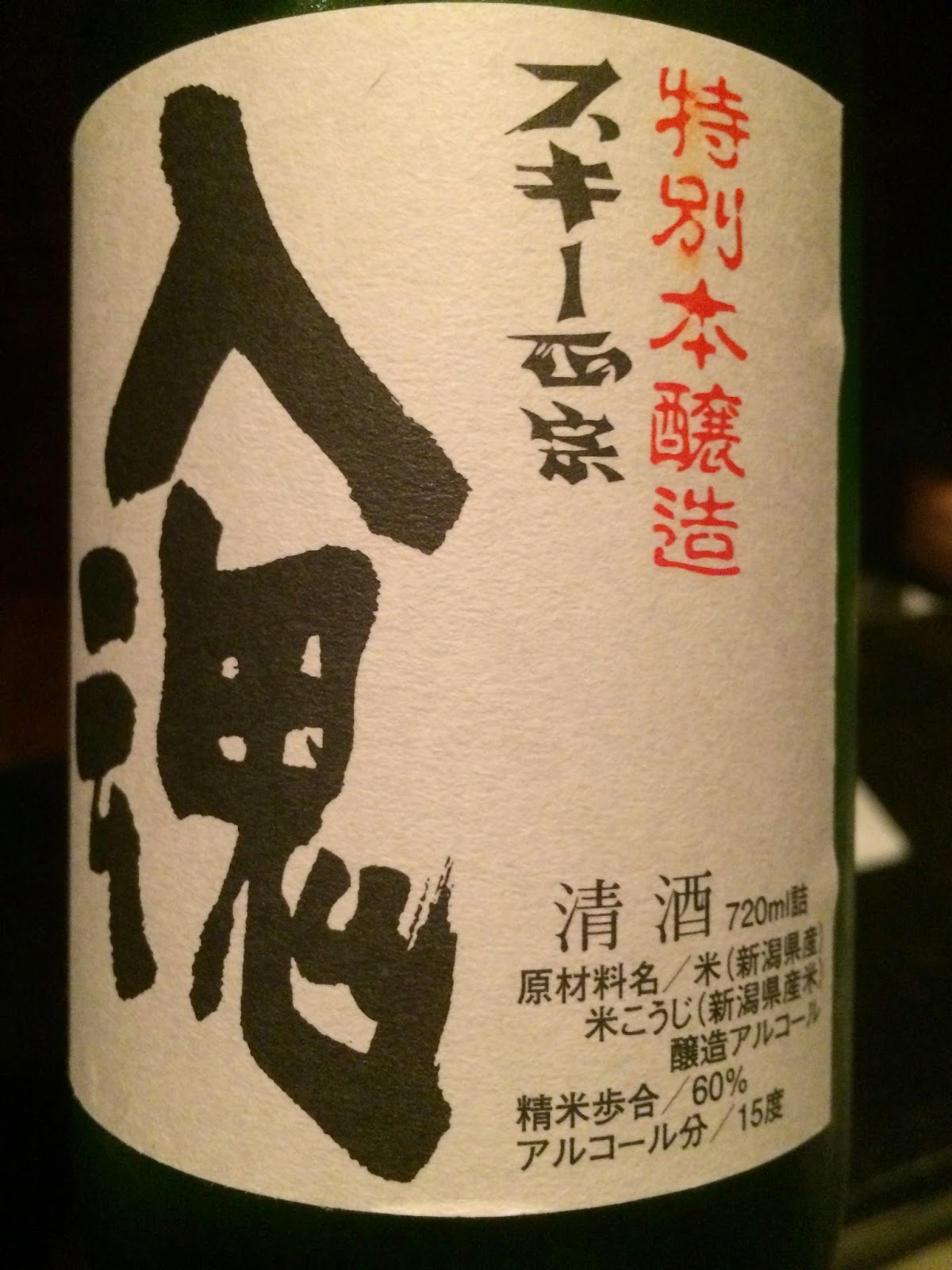
We began with the Nyukon "Into Your Soul" Tokubetsu Honjozo ($52/24 oz), which can retail for around $30 so the markup is less than twice the retail, making it a very good value. Produced by the Musashino Shuzo, which is located in the Niigata Prefecture, they use Gohyakumangoku rice for this Sake which has been polished down to 60%, so it would technically qualify as a Ginjo though they do not label it as such. The taste was dry and clean, with subtle peach and melon flavors, and hints of herbs. Smooth and easy drinking, this was delicious and would appeal to Sake lovers as well as those new to Sake. It went well with our initial dishes, from tofu to seafood. A great starting point for the evening.
We then moved on to the Kamoizumi Shusen Junmai "Three Dots" ($50/30 oz), which can retail for $30-$35 so the markup is less than twice the retail, making it another good value. I should note as well that this bottle is 25% larger than the standard 24 oz bottle. So you get lots of Sake for the price. The Kamoizumi Shuzo, located in the Hiroshima Prefecture, started brewing Sake in 1910, and was one of ten breweries, in 1965, that committed to producing Junmai when nearly everyone else was making Honjozo. They use Hiroshima Hattan rice for this Sake which has been polished down to 58%, so it would technically qualify as a Ginjo though they do not label it as such. Another elegant Sake, this presents with a strong umami taste, more mushrooms and leafy herbs. It has a bit more body than the Nykon, but remains dry, smooth and easy drinking. This would be an excellent Sake with meat dishes.
The final Sake was the Kokuryu Tokusen "Crystal Dragon" Ginjo ($58/24 oz), which can retail for $40-$43 so the markup is less than twice the retail, making it another good value. The name, Kokuryu translates as "Black Dragon" and the name derives from the Kuzu-ryo River ("Nine-headed Dragon" river) in the Fukui Prefecture. They use Gohyakumangoku rice for this Sake which has been polished down to 50%, so it would technically qualify as a Daiginjo though they do not label it as such. This was a more powerful Sake, with bolder flavors of fruit, especially melon, pear and even a bit of cherry. There were depths to the Sake as well, showcasing hints of other, nearly elusive flavors. Definitely a Sake to slowly savor, to enjoy its complexity. It also paired very well with the various Robata skewers we enjoyed.
As for our food choices, we ordered a number of their evening Specials as well as numerous dishes off the menu. As the evening was primarily about enjoyment, I didn't take notes of everything we ate, though I took numerous photos. As such, I can't provide lots of detail of many things we ate, though I can say that everything was delicious, well-presented and I would recommend all of it. This is some of the best Japanese food you will enjoy in Vegas.
Above, is one of their homemade Tofu dishes, accompanied by a spicy side. I'm not a fan of Tofu but I actually enjoyed this dish. The tofu was creamy and clean rather than rubbery, and the spicy side went well atop a piece of the tasty tofu. So even if you dislike tofu, I'd suggest you give it a try at Raku. They have a few different Tofu dishes and they are worth exploring.
One of the Specials was a Tuna Tartare, a silky mound of tender tuna, with only minimal accompaniments, making the dish all about the tuna. I prefer my tartare to be more minimalist, to be more about the meat than what is atop it, and this fit that bill.
A Salad which had bacon, so that automatically elevates it above other salads. Lots of fresh ingredients.
There were two fish on the Specials menu, Flying Fish and Sea Bream, and each was served two ways, as a sashimi and a cooked, whole fish. Above is the Flying Fish sashimi, which had a stronger, but pleasing, flavor than the Sea Bream. The texture of the fish was tender and smooth, with just enough bite to it.
The Sea Bream sashimi possessed a milder taste, with a buttery feel. Very tasty.
The cooked Flying Fish had hearty chunks of meat, strong and tasty flavors with a nice broth.
The Sea Bream's flesh was mild and flaky, with a nice sweetness to the flesh. And the skin had a nice, crispy texture.
The Juicy Deep Fried Chicken also had a great, crispy skin, wrapped around moist and flavorful meat.
One of their specialties is Robata, a charcoal grill that uses binchotan, a traditional Japanese charcoal which burns at a higher temperature than regular charcoal, and also contains less moisture. There are over 30 Robata choices, a variety of skewers of meat, seafood and vegetables. We ordered maybe a dozen or so skewers, including Pork Ear, Duck with Balsamic Soy Sauce, Tomatoes Wrapped in Bacon, and more. It was all excellent, grilled perfectly, and full of interesting flavors. You could easily make a meal of just different skewers.
Raku is one of the best Japanese restaurants in Las Vegas, and also one of the most affordable. If you check out their menu, you will find most items cost under $10, so that even if you go with a group, your bill will still be very reasonable. In addition, their Sake is very reasonably priced, avoiding the outrageous markups that are very too common everywhere else. On the Strip, the Japanese restaurants are generally much more expensive, and it can be hard to find more than a couple items on their menus under $10.
With an excellent Sake list, great service, and a nice diversity of delicious dishes, Raku continues to earn my highest recommendation. If you are traveling to Vegas, make sure to dine at Raku, but just make your reservations as early as possible. Raku is hidden no more, but success hasn't gone to their heads.
Times have changed and Raku is now getting plenty of publicity. For example, it is currently #1 on Eater's 38 Essential Las Vegas Restaurants. You no longer need special insider information to know about this restaurant. However, I worried a little whether the restaurant had changed since my prior visit, whether all that publicity might have had a negative effect on this former hidden treasure. Despite my worries, I knew I still had to dine there again, hoping to recapture some of my previous joy.
On my trip to Vegas a couple weeks ago, I tried to make plans to dine at Raku and quickly noticed one change, that it was tougher to get a reservation there, even on a Tuesday evening. So if you want to dine there, I highly recommend making reservations as far ahead of time as possible. Fortunately, the five of us were able to get a table on a Thursday evening, and they sat us in a small private room that only had two tables.
I certainly enjoyed the intimacy of this room and I'm pleased to report that our dinner at Raku was as good, if not better, than my prior visit. The quality of their food has not diminished in the least, and their Sake list has exapnded. All of my friends were impressed with the cuisine, especially considering its affordability. Service was excellent and I continue to give Raku my highest recommendation. Fame has not diminished Raku in the least.
Raku's Sake menu appears to have grown, and now contains over 75 selections, from Junmai to Honjozo, Ginjo to Daiginjo, along with some Sparkling Sake and Nigori. Excellent diversity and plenty of interesting choices. Over 50 of the selections are available by the glass and some in "half" bottle formats. Price markups seem low, some of the best I've seen at any Japanese restaurant, and you could definitely while away an evening sampling and enjoying various Sakes. During the course of our dinner, we ordered three different bottles of Sake, none of which I had previously tasted. I wanted to experience something different, to continue expanding my Sake horizons.
We began with the Nyukon "Into Your Soul" Tokubetsu Honjozo ($52/24 oz), which can retail for around $30 so the markup is less than twice the retail, making it a very good value. Produced by the Musashino Shuzo, which is located in the Niigata Prefecture, they use Gohyakumangoku rice for this Sake which has been polished down to 60%, so it would technically qualify as a Ginjo though they do not label it as such. The taste was dry and clean, with subtle peach and melon flavors, and hints of herbs. Smooth and easy drinking, this was delicious and would appeal to Sake lovers as well as those new to Sake. It went well with our initial dishes, from tofu to seafood. A great starting point for the evening.
We then moved on to the Kamoizumi Shusen Junmai "Three Dots" ($50/30 oz), which can retail for $30-$35 so the markup is less than twice the retail, making it another good value. I should note as well that this bottle is 25% larger than the standard 24 oz bottle. So you get lots of Sake for the price. The Kamoizumi Shuzo, located in the Hiroshima Prefecture, started brewing Sake in 1910, and was one of ten breweries, in 1965, that committed to producing Junmai when nearly everyone else was making Honjozo. They use Hiroshima Hattan rice for this Sake which has been polished down to 58%, so it would technically qualify as a Ginjo though they do not label it as such. Another elegant Sake, this presents with a strong umami taste, more mushrooms and leafy herbs. It has a bit more body than the Nykon, but remains dry, smooth and easy drinking. This would be an excellent Sake with meat dishes.
The final Sake was the Kokuryu Tokusen "Crystal Dragon" Ginjo ($58/24 oz), which can retail for $40-$43 so the markup is less than twice the retail, making it another good value. The name, Kokuryu translates as "Black Dragon" and the name derives from the Kuzu-ryo River ("Nine-headed Dragon" river) in the Fukui Prefecture. They use Gohyakumangoku rice for this Sake which has been polished down to 50%, so it would technically qualify as a Daiginjo though they do not label it as such. This was a more powerful Sake, with bolder flavors of fruit, especially melon, pear and even a bit of cherry. There were depths to the Sake as well, showcasing hints of other, nearly elusive flavors. Definitely a Sake to slowly savor, to enjoy its complexity. It also paired very well with the various Robata skewers we enjoyed.
As for our food choices, we ordered a number of their evening Specials as well as numerous dishes off the menu. As the evening was primarily about enjoyment, I didn't take notes of everything we ate, though I took numerous photos. As such, I can't provide lots of detail of many things we ate, though I can say that everything was delicious, well-presented and I would recommend all of it. This is some of the best Japanese food you will enjoy in Vegas.
Above, is one of their homemade Tofu dishes, accompanied by a spicy side. I'm not a fan of Tofu but I actually enjoyed this dish. The tofu was creamy and clean rather than rubbery, and the spicy side went well atop a piece of the tasty tofu. So even if you dislike tofu, I'd suggest you give it a try at Raku. They have a few different Tofu dishes and they are worth exploring.
One of the Specials was a Tuna Tartare, a silky mound of tender tuna, with only minimal accompaniments, making the dish all about the tuna. I prefer my tartare to be more minimalist, to be more about the meat than what is atop it, and this fit that bill.
A Salad which had bacon, so that automatically elevates it above other salads. Lots of fresh ingredients.
There were two fish on the Specials menu, Flying Fish and Sea Bream, and each was served two ways, as a sashimi and a cooked, whole fish. Above is the Flying Fish sashimi, which had a stronger, but pleasing, flavor than the Sea Bream. The texture of the fish was tender and smooth, with just enough bite to it.
The Sea Bream sashimi possessed a milder taste, with a buttery feel. Very tasty.
The cooked Flying Fish had hearty chunks of meat, strong and tasty flavors with a nice broth.
The Sea Bream's flesh was mild and flaky, with a nice sweetness to the flesh. And the skin had a nice, crispy texture.
The Juicy Deep Fried Chicken also had a great, crispy skin, wrapped around moist and flavorful meat.
One of their specialties is Robata, a charcoal grill that uses binchotan, a traditional Japanese charcoal which burns at a higher temperature than regular charcoal, and also contains less moisture. There are over 30 Robata choices, a variety of skewers of meat, seafood and vegetables. We ordered maybe a dozen or so skewers, including Pork Ear, Duck with Balsamic Soy Sauce, Tomatoes Wrapped in Bacon, and more. It was all excellent, grilled perfectly, and full of interesting flavors. You could easily make a meal of just different skewers.
Raku is one of the best Japanese restaurants in Las Vegas, and also one of the most affordable. If you check out their menu, you will find most items cost under $10, so that even if you go with a group, your bill will still be very reasonable. In addition, their Sake is very reasonably priced, avoiding the outrageous markups that are very too common everywhere else. On the Strip, the Japanese restaurants are generally much more expensive, and it can be hard to find more than a couple items on their menus under $10.
With an excellent Sake list, great service, and a nice diversity of delicious dishes, Raku continues to earn my highest recommendation. If you are traveling to Vegas, make sure to dine at Raku, but just make your reservations as early as possible. Raku is hidden no more, but success hasn't gone to their heads.
Consumers & Seafood Certification
Seafood sustainability is a complex issue, especially for consumers. They feel overwhelmed by the myriad of issues and often are unwilling to take the time and effort to ask the necessary questions of a seafood purveyor or restaurant to determine whether a specific seafood is sustainable or not. They also can get confused by the conflicting information they receive from the media, such as whether aquaculture is sustainable or not. The media tends to showcase negative information about seafood, four times more than they showcase positive articles, and they often tend to exaggerate the perils.
What can a consumer do to more easily determine whether a specific seafood is sustainable or not?
Consumers need something simple, quick and trustworthy, and third party certifications can provide that solution. Such third party certifications can provide labels for seafood, vouching for the sustainability of the product, and consumers can then rely on those labels when purchasing seafood. That makes the buying decision much easier for consumers. They don't need to spend time asking lots of questions of the purveyor. All they have to do is look for a trusted label. It couldn't be any simpler for them.
There are a growing number of third party certifications for seafood sustainability, from the Marine Stewardship Council (MSC) to the Aquaculture Stewardship Council (ASC). Each has its own standards and covers its own types of seafood. There are also organizations such as the Monterey Bay Aquarium Seafood Watch which provide seafood sustainability recommendations but don't issue actual certifications. All of these groups do the difficult work of sustainability assessment, making their results available to the general public, and often for free.
Consumers need to understand a few basics about such certifications, and be willing to trust their decisions. It won't be the average consumer though who generally questions these certifications. Instead, it will be a passionate minority who will step up and inquire into those third party certifications. They will be the ones who question everything, including their motivations, knowledge level, biases and more. And that minority will then inform the general public, indicating which certifications are trustworthy or not.
As for the basics consumers need to know, they first need to understand that these certifications exist, and that they indicate the sustainability of the seafood. That requires such certification organizations to engage in media campaigns to make consumers aware of their existence. It requires fish markets, grocery stores, restaurants and others to make their customers aware of the certification labels on their seafood. It needs the media to spread the word, highlighting the positive work of these certification bodies. Unless consumers are educated, they won't be able to select seafood based on these certifications.
Second, consumers must learn that they cannot rely on a single certification for all their seafood decisions. Instead, they need to accept the validity of multiple certifications, as each specific certification has its limitations. For example, the MSC only certifies wild fisheries while the ASC only certifies aquaculture. Both certifications are equally valid and indicate sustainable seafood, just in different areas. If consumers seek only a single certification label, then they will be missing out on plenty of sustainable seafood.
If consumers start relying on these third party certification labels, then it will likely lead to more fisheries, both wild and farmed, to seek out certifications and that will lead to greater sustainability in the seafood industry. Educating consumers then about these labels is essential to the continued vitality of the seafood industry. As the importance of seafood grows, especially due to its potential to address the future food crisis, then the importance of sustainability becomes even more vital.
Another advantage to the proliferation if third party certification groups is that it seems to be leading to the creation of even stricter standards. The different groups want to differentiate themselves from the others and adhering to stricter standards is one way to do so. For example, the ASC, which was founded in 2010, created standards which include social issues, from worker safety to wages. This could be the future of sustainability, a consideration of not only the health of the oceans and fish, but also the health and safety of the workers involved in the industry. The more certification groups that embrace such social standards, makes the seafood industry better for all.
Spread the word about third party certifications, and let consumers understand their value. Let's have more consumers opt for sustainable seafood by making it easier for them to do so.
Rant: Wine Is Losing Ground
Wine isn't as popular as it used to be, and beer is becoming a more favored choice. For several years, some have claimed that Millennials were the future of wine, that they would consume more wine than any previous generation. I voiced my doubts, worried that all of the new craft beers and spirits might capture the attention of Millennials. Based on a recent Gallup poll, craft beers might be replacing wine as the drink of choice.
For more than twenty years, beer has usually been the preferred drink of Americans, except for a brief moment in 2005 when wine surpassed beer. This year, beer has been on an upward surge, preferred by 41% of Americans while wine has been on the decline, preferred by only 31%. Those who prefer spirits was at 23%, which has slowly been climbing. It doesn't appear that the infusion of Millennials has been boosting the number of Americans who prefer wine. Instead, it seems beer and spirits may be capturing more of their attention.
When the results are broken down by demographics, the situation becomes even more interesting. 46% of women prefer wine while only 17% of men prefer it (and 57% of men prefer beer). A nearly 30% difference is astounding. Why do so few men prefer wine? Why does wine appeal more to women? Do wine marketers need to appeal more to men? How do they do that? With such a large discrepancy, then why are more wine blogs written by men? The number of female written wine blogs has been increasing each year, but men still author the majority.
Age also plays its part in one's preferences. Generally, the younger the group, the more they prefer beer. For example, those 18-34 years old prefer beer 48% while those 35-54 prefer beer only 43%, and those older prefer wine over beer, 38% to 32%. Millennials, especially males, are opting more for beer than wine. That will likely change as they get older, but it seems as if it will fall into old patterns, and not create anything new.
Roughly 64% of American adults drink alcohol, with the rest identifying as "total abstainers." This is roughly the same as it has been since the end of Prohibition. That is also a fascinating fact, that despite the production over the years of higher quality wine, beer and spirits, the total amount of drinkers has remained relatively stable, with only minor fluctuations.
How can wine regain ground against craft beers and spirits? How can we get more men to prefer wine? Are women the future of wine? These are all important questions that wineries, marketers, PR people, and others should be considering. Writers should also be exploring these issues, as well as considering the demographics of their readers.
Sage in Vegas: A Worthy Splurge
From France to Lebanon to South Africa, a fascinating vinous journey to begin our Vegas vacation. Enhancing the experience, the wines accompanied compelling dishes, creating a superb culinary evening.
Dinner at the Sage restaurant in the Aria Hotel.
While deciding on which restaurants to patronize while in Vegas, my good friend Adam recommended Sage. He had dined there previously and couldn't rave about his experience enough. I trust his palate and had also read some other very positive reviews of Sage, so we decided to dine there one evening. Due to scheduling issues, we ended up going to Sage on our first evening in Vegas, and the experience set a high bar for the rest of the trip. It was a top notch dinner, with excellent wines and attentive service. A perfect choice.
Sage serves "contemporary American cuisine spiced with global influences" and includes "farm-to-table produce, artisanal meats and sustainable seafood.." Chef Shawn McClain, who also owns the Green Zebra in Chicago, is originally from San Diego. He has spent much of his culinary career in Chicago, and opened Sage in Vegas in 2009. This is a high-end restaurant, with an elegant ambiance that avoids being pretentious. The restaurant's initial dining area, which is a bit more casual, also has a lengthy bar, while the second dining area is the more elegant.
The food menu has several options, from a la carte choices to a few different tasting menus. There is a three-course Early Evening Menu ($59), a four-course Signature Tasting Menu ($89) and an eight-course Chef's Tasting Menu ($150). On the a la carte menu, you will find Starters (9 choices at $16-$27), Salads (3 choices at $18-$24), Steaks & Braises (4 choices at $41-59), Lighter Meats (3 choices at $37-$44), and Pasta & Seafood (4 choices at $41-$44). There were no Specials on the evening we dined, but the menu has plenty of interesting choices.
The wine list at Sage was intriguing and diverse, and the prices were not outrageous. We spoke with the Master Sommelier, Nick Hetzel, and he was knowledgeable, personable and passionate. The list he composed has some big names, but also some intriguing, lesser known, but still excellent, wines. This is clearly a restaurant which has a passion for wine, and which wine lovers will cherish.
We started off with the Catherine et Pierre Breton "Le Dilettante" Vouvray Brut, a sparkling wine from the Loire. The winery is certified organic and is also seeking Biodynamic certification. Made in the méthode traditionnelle, this wine is produced from 100% Chenin Blanc, the vines which are about 40 years old. Dry and compelling, there were delicious tastes of peach and apple, with hints of citrus, spice and an underlying minerality. It was clean and refreshing, an excellent way to begin our meal, and a wine I would recommend to any lover of bubbly.
I began my dinner with the Roasted Veal Sweetbreads ($18), which come with glazed bacon, creamy white polenta and trumpet mushrooms. Who wouldn't love that large, thick slab of glazed bacon atop the dish? Tender and flavorful, it went well with the slightly crunchy coating of the sweetbreads and their moist interior. Everything in this dish was delicious and worked well together, such a delight of textures and flavors. Highly recommended.
Our second wine was the unique 2001 Chateau Musar Blanc, a Lebanese white wine. I've previously enjoyed red wines from Chateau Musar but never had one of their whites before. This wine is made from two indigenous grapes, Obaideh and Merwah, and is fermented in French oak barriques for 9 months. It is then bottled but not released until 7 years after harvest, so this wine was not released until 2008. It is a slightly oxidized style, and I loved it. More full bodied, it possessed a complex melange of flavors which intrigued my palate. Notes of honey and apricot, smoke and caramel, citrus and pear. Each sip seemed to bring new flavors to mind, and it evolved over the course of the dinner, getting more intriguing as the night went on. Highly recommended, and this wine appears to be available in Massachusetts through Ruby Wines.
For my second course, I chose a Melon Salad (which is not listed on their online menu) with thin strips of pork belly as well as strips of ricotta cheese. A nice combination of flavors and textures, with the fresh fruit of the melon and the saltiness of the pork belly and ricottta. A refreshing palate cleanser after the heavier dish of sweetbreads.
Our next wine was the 2012 Sadie Family Die Ouwingerdreeks Soldaat, a South African wine from the Swartland region. "Soldaat" means "soldiers" and this wine is made from 100% Grenache Noir, reminding me of some Rhône wines. The bold fruit flavors, from cherry to strawberry, were enhanced by spicy & earthy notes. It seemed both fresh and mature, an interesting dichotomy which made this a fascinating and delicious wine. Restrained tannins, a lengthy finish, and nice acidity make this another wine I highly recommend.
And a perfect pairing for the Soldaat was the Bacon-Wrapped Iberico Pork Loin ($44), with smoked apple, asparagus, and celery root panna cotta. The pork alone was wonderful, tender and rich in flavor, and the bacon only made it more hedonistic. This is one of their signature dishes and I understand its popularity. A fine entree which is going to satisfy any pork lover.
The Dessert menu has 8 choices, priced $14-$20, and I opted for a Watermelon Mousse dish (which is not listed on their online menu). As I wasn't taking formal notes, I am unsure what else what on this dish. I do recall though that it was tasty, with a variety of textures, from creamy to crunchy, with some savory elements too.
Overall, this was an excellent dining experience and I highly recommend Sage. Service was professional and attentive, the food was well-presented and delicious, and the wines were killer. If you are going to splurge on dinner in Vegas, Sage would be a great choice.
Thursday Sips & Nibbles
I am back again with a new edition of Thursday Sips & Nibbles, my regular column where I highlight some interesting wine and food items that are upcoming. **********************************************************
1) Legal Oysteria, Legal Sea Foods’ newest concept in Charlestown, now offers weekend lunch service. Executive Chef Rich Vellante and Restaurant Chef Gina Palmacci have designed a menu of coastal Italian-style seafood that will be served in this casual neighborhood restaurant.
For appetizers, there are eight options including: New England Clam Chowder; Charred Octopus (tomato, potato, coriander vinaigrette - $10); Braised Mussels (fideos, chorizo, red wine tomato sauce - $9); Seafood Antipasto (shrimp, squid, octopus, olives - $10.50); and, Eggplant Caponata Dip (warm focaccia - $8.50). There are also a variety of “Small Plates” ($3-5), including Chickpea & Shrimp Fritters (chorizo mayo), Smoked Salmon (dill mascarpone) and a trio of Oyster preparations (raw, grilled and baked).
From the old world brick oven with true clay-based fire bricks, three pizzas will be dished out: Margherita (fresh mozzarella, tomato, basil - $10); Roasted Clam (garlic, oregano, mozzarella, pecorino - $11); and, Sopressata (stracciatella, banana peppers, spicy red sauce - $12). Salads can come topped with a choice of grilled shrimp, swordfish, salmon or chicken and include Baby Romaine (pint nuts, dried grapes, parmigiano vinaigrette - $8) and Treviso Radicchio & Escarole (lemon anchovy dressing - $9).
There are eight entrée and pasta options, such as: Steak Sandwich (pancetta, mortadella, caciocavallo, egg, polenta fries - $15); Pan Roasted Salmon (salsa verde, marinated zucchini - $17); Baked Eggs in Tomato Sauce (chickpeas and fontina, whole wheat olive toast); Cannoli Pancakes (ricotta filled crespelle, strawberries, maple syrup - $7); and, Linguini & Clams ($17). For sides, six a la carte options are offered ($3-4), including Oven Roasted Cipollini, Charred Carrots and Heirloom Bean Salad.
Legal Oysteria will be open for weekend lunch service on Saturdays and Sundays from 11am to 4pm.
2) On Tuesday, August 19, at 6:30pm, Legal Harborside will team up with Massimo Galvano, Italian Wine Director of Kobrand Wine & Spirits, for an exclusive four-plus-course Italian wine dinner. Kobrand’s Italian estates are renowned for their diverse and extensive terrain ranging from warm Mediterranean climates to cool hillsides and mountains which produce complex yet diverse flavors.
The menu will be presented as follows:
SFIZI
Baked Clam with Ciabatta Pancetta Crumbs
Chilled Melon Soup with Crispy Prosciutto
Black Bass Crudo with Tuscan Olive Oil
Baccala Fritter, Salsa Verde, Grilled Lemon Aioli
Michele Chiarlo “Le Marne” Gavi, Piemonte, 2013
ANTIPASTI
Grilled Octopus (Marble Potato, Braised Cipolini, Smoked Tomato, Coriander Oil)
Nozzole “La Forra” Chianti Classico Riserva, Toscana, 1997
Nozzole “La Forra” Chianti Classico Riserva, Toscana, 2008
PASTA COURSE
Veal Cheek Ravioli (Prosciutto-Wrapped Monkfish, Crispy Sage)
Silvio Nardi Rosso di Montalcino, Toscana, 2010
Silvio Nardi “Manachiara” Brunello di Montalcino, Toscana, 2003
SECONDI COURSE
Roasted Lamb Loin (Braised Lamb Belly, Smoked Lentils, Graffiti Eggplant, Slow Roasted Mushrooms)
Michele Chiarlo “Tortoniano” Barolo, Piemonte, 2009
Michele Chiarlo “Cannubi” Barolo, Piemonte, 2003
DOLCE
Summer Peach Torta
Amaretto Mascarpone Cream, Raspberry
Michele Chiarlo “Nivole” Moscato d’Asti, Piemonte, 2012
COST: $125 per person (excludes tax & gratuity)
Reservation required by calling 617-530-9470
3) Executive Chef/Partner Robert Sisca and Head Sommelier Todd Lipman of Bistro du Midi present the fourth month of the five-part Summer Rosé Tour, running now through September. To celebrate the summer months and embrace the ever-growing popularity of Provencal Rosé, Bistro du Midi is offering an experience for guests to enjoy the wine and cuisine of Nice, Marseille, Toulon, Saint-Tropez, and Cannes. Guests can expect a unique Rosé to be offered by the glass and in multiple pouring sizes. These selections pair with Chef Sisca’s signature crudo selection, as well as alongside featured menu additions from Chef Sisca that embrace the regional specialties of major Provencal towns.
For August, the selection is from Toulon with Château Miraval. It includes:
--2013 Château Miraval Rosé, Côtes de Provence $13 / $19.50 / $29 / $58
--Small Plate
Brandade Beignets (Pimento Aïoli) $10
--Large Plate
Grilled Red Snapper (Arugula & White Peach Salad, Lemon Vinaigrette) $21
Both plates and a glass of rosé $39
Vegas, J Sake Bar & Mioya Yuho Yama-oroshi
While planning my trip to Las Vegas, I did some research on the best places to find Sake. As I hadn't been there in several years, I knew there had to be some new places to check out, and I found one. The J Sake Bar, located a short distance off the Strip at 4459 West Flamingo Road, has only been open since the end of April, and they do not even have a website, just a Facebook page. As such, there also is not a menu of their food or Sake online. Hopefully that will be remedied in the near future, so people can see what they carry.
The Sake bar is open Tuesday through Sunday, from 7pm-3am, and they carry over 100 different Sakes, in numerous formats from small cans to large ishobins. My friends and I stopped there after our dinner at Anriya Raku, planning to have a drink. We didn't order any food, and really didn't even consult the food menu, because we had already eaten plenty at dinner. However, I delved into the Sake list, and was pleased with the diversity I found. This is definitely a place I want to return to, and spend more time exploring the Sake list and trying some of their food. It is a place with lots of potential, though it needs to provide more information online for potential customers.
I chose to drink the Mioya Shuzo Yuho "Rhythm of the Centuries" Yama-oroshi Junmai Kimoto. That sounds like a mouthful, but it is rather easy to understand. Mioya Shuzo, founded in 1897, is the name of the Sake brewery and it is located in the Ishikawa Prefecture. It is especially unique as it is one of the only breweries with a female president, Miho Fujita, and she also participates in the brewing. The "Yuho" line was created to showcase Sake with bold flavors and umami, and the term means "happy rice" though it also refers to the area's frequent UFO sightings. Flying saucers & Sake?
The Sake uses Notohikari rice, that has been polished down to 55%, which would qualify it as a Ginjo though it is only labeled as a Junmai. It has a higher acidity, at 2.2, than the usual Junmai. The Sake was produced using the ancient Kimoto method, where large oar-like poles, called yama-oroshi, are continually rammed into the yeast starter to produce a paste. This is a laborious task, which is rarely performed in modern breweries, but which can create intriguing Sake, often with a more earthy or gamey taste, as well as greater umami. The Mioya brewery has been using the Kimoto method since its founding.
Most Sake is aged for six months to a year before it is released, but this Yuho is aged for about four years prior to release. This may be why the Sake is so smooth on the palate, an easy drinking liquid which goes down far too quickly. It has a powerful umami taste, with underlying elements of earthiness, some citrus flavors and even Sherry notes on the finish. Nice acidity, a lengthy finish and plenty of complexity. An excellent choice, it garners my highest recommendation and I think it will be enjoyed not only by Sake lovers, but also those new to Sake.
Good luck to the J Sake Bar!
The Sake bar is open Tuesday through Sunday, from 7pm-3am, and they carry over 100 different Sakes, in numerous formats from small cans to large ishobins. My friends and I stopped there after our dinner at Anriya Raku, planning to have a drink. We didn't order any food, and really didn't even consult the food menu, because we had already eaten plenty at dinner. However, I delved into the Sake list, and was pleased with the diversity I found. This is definitely a place I want to return to, and spend more time exploring the Sake list and trying some of their food. It is a place with lots of potential, though it needs to provide more information online for potential customers.
We sat at the bar and our server was personable and accommodating, making us all feel welcome. For a Thursday evening, close to midnight, it wasn't very busy though that could be because it is not well known yet. Being off the Strip, visitors to Vegas generally have to take the effort to get there, which many may not do unless they are provided sufficient reason to do so. So, such restaurants and bars need to spread the word wide and far, to gain the notice they deserve.
I chose to drink the Mioya Shuzo Yuho "Rhythm of the Centuries" Yama-oroshi Junmai Kimoto. That sounds like a mouthful, but it is rather easy to understand. Mioya Shuzo, founded in 1897, is the name of the Sake brewery and it is located in the Ishikawa Prefecture. It is especially unique as it is one of the only breweries with a female president, Miho Fujita, and she also participates in the brewing. The "Yuho" line was created to showcase Sake with bold flavors and umami, and the term means "happy rice" though it also refers to the area's frequent UFO sightings. Flying saucers & Sake?
The Sake uses Notohikari rice, that has been polished down to 55%, which would qualify it as a Ginjo though it is only labeled as a Junmai. It has a higher acidity, at 2.2, than the usual Junmai. The Sake was produced using the ancient Kimoto method, where large oar-like poles, called yama-oroshi, are continually rammed into the yeast starter to produce a paste. This is a laborious task, which is rarely performed in modern breweries, but which can create intriguing Sake, often with a more earthy or gamey taste, as well as greater umami. The Mioya brewery has been using the Kimoto method since its founding.
Most Sake is aged for six months to a year before it is released, but this Yuho is aged for about four years prior to release. This may be why the Sake is so smooth on the palate, an easy drinking liquid which goes down far too quickly. It has a powerful umami taste, with underlying elements of earthiness, some citrus flavors and even Sherry notes on the finish. Nice acidity, a lengthy finish and plenty of complexity. An excellent choice, it garners my highest recommendation and I think it will be enjoyed not only by Sake lovers, but also those new to Sake.
Good luck to the J Sake Bar!
Subscribe to:
Posts (Atom)


